Saturday, April 11, 2009

PARAGALLO RAKING IN MILLIONS IN STUD FEES


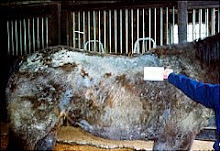
He's gonna need all the money he can get, to pay the vet bills on 177 starving and neglected horses.

Paragall Raking in Millions By Ray Paulick

Ernie Paragallo may or may not have financial problems in his private life. But he very likely has a legal problem, stemming from the reported discovery on his upstate New York farm of horses that were not being fed or cared for properly or humanely. Police in New York on Wednesday took control of Center Brook Farm and its 170-plus equine occupants.

In one published report, Paragallo claims to be spending $5,000 per week on feed for the horses on his farm. That sounds like a lot of money to many of us, but Paragallo has played at the top end of the racing and breeding world. One of his racing stable’s former stars, Unbridled’s Song, winner of the $1-million Breeders’ Cup Juvenile in 1995, has been an extremely successful stallion, standing as the property of a syndicate at Taylor Made Farm in Kentucky.

Unbridled’s Song is the sire of two of this year’s leading Kentucky Derby contenders, Old Fashioned and Dunkirk.

According to sources, Paragallo owns as many as 20 of the 40 shares in Unbridled’s Song, whose 2009 live foal stud fee is $125,000 (down from $150,000 in 2008, and $200,000 in 2007). Each of those shares leads to roughly two live foals per year, meaning that if Paragallo owns 20 shares he will get $5 million or more in revenue in stud fees from Unbridled’s Song when this breeding season’s foals are born in 2010 (20 shares=40 foals, times $125,000 stud fee). Over a three-year period (factoring in the higher fees from 2007-08), Paragallo’s revenue from Unbridled’s Song could approach $20 million.

Yes, he certainly can afford to feed and provide proper veterinary care for his horses.


http://www.paulickreport.com/blog/paragallo-raking-in-millions-in-stud-fees/

GOTCHA! CAMERA CATCHES CHARLES TOWN CLERK, JOCKEYS FUDGING

More Black for the Industry Eye

"Gotcha!" By Ray Paulick

Michael Garrison had his occupational permit revoked and he was fined $1,000 and suspended indefinitely as the clerk of scales at Charles Town Races & Slots in West Virginia after an investigation determined he was not reporting overages of assigned weights of riders weighing out before races. Seven jockeys were suspended 30 days and fined $1,000 each for violation of the West Virginia rules of racing pertaining to riding weights and dishonest or corrupt practices.

Garrison was escorted off the Charles Town premises by security personnel following the first race March 27, according to chief steward Danny Wright and association steward Robert Lotts. Acting on an anonymous tip, track security had installed surveillance cameras in the weigh-out area adjacent to the clerk of scales office and Garrison was allegedly observed being derelict in his duties by not reporting overweights of the riders.

After hearings were conducted on Wednesday, the fines and suspensions were announced. The seven jockeys suspended are: Alexis Rios Conde, Tony Maragh, Anthony Mawing, Luis Perez, Lawrence Reynolds, Jesus Sanchez, and Dale Whittaker. The suspensions are effective from today (April 9) through May 8.

Garrison refused to testify at the hearing, according to Kelli Talbott, deputy attorney general representing the West Virginia Racing Commission. He was suspended for failing to use due diligence in the performance of his duty as clerk of scales, in violation of West Virginia rules of racing.

No evidence was presented that bribes may have been involved.

“No riders admitted to accepting or giving money or anything of that nature,” Wright told the Paulick Report. “That never materialized.”

Former rider Mark Munden has assumed the clerk of scales duties.


http://www.paulickreport.com/blog/gotcha-camera-catches-charles-town-clerk-jockeys-fudging/

Paragallo: Investigations before the Bust


NY - Under Investigation, Paragallo Says Some Horses He Owns Are Underweight

By JOE DRAPE
Published: April 6, 2009

The Society for the Prevention of Cruelty to Animals is investigating
whether Ernie Paragallo, a prominent New York thoroughbred breeder
and owner, has neglected and abused horses on his Center Brook Farm.

Ron Perez, the president of the Columbia-Greene Humane Society/
S.P.C.A., said investigators had been on the farm in Climax, N.Y., south
of Albany, within the past 10 days. He also acknowledged that a woman
who had picked up two horses that were malnourished and infected with
parasites filed a complaint with the state police on Saturday.

The woman, Colleen Segarra, said she was allowed into a barn where at
least 16 other horses showed signs of distress and neglect. She said they
had no bedding, like woodchips, and were severely undernourished.

"You could see their hips and spines and they had lice," said Segarra, who
is a member of the New York State Horse Council, an animal-protection
group. "They were in debilitating condition."

Segarra said she offered to take more horses off the farm as well as to
summon and pay for a veterinarian to tend to them, but was told by
Center Brook's farm manager that she could not without Paragallo's
permission. She told the police that the manager had said that he
had not been provided with enough food over the winter and that he
had trouble properly feeding the more than 125 horses on the
511-acre farm.

Paragallo denied those charges and said he had spoken to and was
cooperating with investigators from the S.P.C.A., a nonprofit organization
that has legal authority to make arrests in cases of animal cruelty.
Paragallo said he provided 14.7 tons of hay and 5,000 pounds of feed
a week for his horses.

"It was a rough winter," Paragallo said Monday. "I'm not going to lie —
there's seven or eight that are maybe 75 or 100 pounds underweight.
The investigators suggested we change our feed, and we're doing so.
There's a mare there that we're feeding three times a day."

Paragallo has been a fixture on the American racing scene since the
early 1990s when he was a leading buyer of yearlings and 2-year-olds
at auctions in Kentucky, New York and Florida. On Saturday, he was
at Aqueduct watching his colt Cellar Dweller compete in the Wood Memorial.

In 1994, Paragallo purchased Unbridled's Song for $200,000 at a Saratoga Select Yearling Sale, and the colt went on to win the Florida Derby and the Wood Memorial, where he sustained a cracked hoof. That injury was blamed for his disappointing fifth-place finish in the 1996 Kentucky
Derby, where he was the favorite. Still, Unbridled's Song — of whom
Paragallo owns half — is one of the most successful stallions in horse
racing, commanding a $125,000 stud fee and producing more than
100 horses that won $1 million.


Since 1996, Paragallo's family-owned Paraneck Stable has been among
the nation's leading racing outfits, starting 4,686 runners that have
earned $20.6 million in purse money.

The S.P.C.A.'s Perez declined further comment because the investigation
was continuing. In New York, a person found guilty of animal cruelty, a
misdemeanor, can face up to one year in jail and a $1,000 fine for each
count.

Several individuals and rescue groups have come forward with harrowing
tales of horses under Paragallo's care. Last month, four undernourished
and neglected former racehorses belonging to him were rescued from a
New York kill pen, one step from being slaughtered.

They were among more than 20 horses from Paragallo's farm that were
sold to slaughter for $680.

Paragallo said he had given the horses to a Florida-based breeder in
December with the agreement that he could breed the mares back to one
of his stallions based in New York or Florida. However, a horse transporter,
Richie Baiardi, said that he had picked them up at Paragallo's farm at the
end of February with the intention of taking them to Florida but could not
because of they were "bags of bones, literally walking hides," and would
not have survived the trip.

All four mares are being rehabilitated by Another Chance 4 Horses, a
horse-rescue group, at its farm in Bernville, Pa. Three other mares are
recovering at a boarding and training center in Fulton, N.Y., operated
by Lisa Leogrande, who discovered the horses in the kill pen.

In January 2007, another rescue group, Equine Advocates, took three
horses from Center Brook; they required more than a month in an equine
hospital in Saratoga Springs, N.Y. The veterinarian who treated them,
Dr. Bill Barnes, said the horses were "starving to death."

Another Chance 4 Horses and Equine Advocates have produced
photographs that show the horses coming off the farm undernourished
and unhealthy.

Segarra said the two horses she removed Saturday, a mare named
Hunter's Circle and a yearling she produced by the Paragallo stallion
Griffinite, were "badly debilitated."

She said: "The yearling looked like a weanling, and the veterinarian I
had look at them said it would take at least six months to rehabilitate
both of them. I wanted to take more with me. The ones I had to leave
behind are haunting me."

Friday, April 10, 2009

NY TB Breeder Starves 177 Horses


Thursday, April 9, 2006:

One-hundred and seventy-seven (177) neglected thoroughbred horses were confiscated today from Paraneck Stables, a thoroughbred breeding farm in Greene Co., NY., manged by Ernie Paragallo, owner of "Center Brook Farm," another thoroughbred breeding facility.

Article; http://www.lohud.com/article/20090409/NEWS05/904090483

Please call the appropriate authorities as listed below to request full prosecution of this case. Remind them that animal cruelty and neglect are serious crimes and we are talking about 117 living beings here!

New York State Dept. of Agriculture & Markets
John Huntley, DVM, Director (518) 457 - 3502
http://www.agmkt.state.ny.us/AI/AIHome.html

Greene Co. Prosecutor,Stephen K. Haller
(937) 562 - 5250
http://www.co.greene.oh.us/prosecutor/default.htm

The horses are in the care of;
The Columbia Greene Humane Society
and SPCA;
http://www.cghs.org/

CGHS/SPCA has been helping animals since 1955, they are a no-kill facility that receives no public support. We heartily urge you to give them support now if you are able. You can imagine the cost involved in caring for 177 severley neglected horses. I am sure anything you may be able to give, even the smallest amount, will be greatly appreciated.

You can email them at;
GCHSuser001@aol.com
for more information or
you can make a donation through Paypal by clicking the link below;

http://www.cghs.org/navigation.htm

or give by credit card over the phone.
Contact Katrina or Ron at (518) 828-6044 and tell them you would like
to contribute to the horse fund.


Click on title above for petition calling for full prosecution of this case;
http://www.thepetitionsite.com/1/ny-tb-breeder-starves-177-horses

NY Breeders Out of Control

New York State has some of the most lucrative race-horse breeding incentive programs in the entire country. For New York breeders, the rewards go beyond the mere selling off of offspring, as they continue earning dividends throughout their horses' New York racing careers. And at the $30,000 claiming level and above, owners can earn additional money for simply campaigning a New York-bred in New York State. For registered New York stallions, the stallion owner continues to benefit financially beyond the standard stallion stud fees as his or her stallion's progeny race and earn purse money at New York racetracks.
In addition, there is the New York Stallion Stakes Series, which is restricted to eligible progeny of nominated registered New York-based stallions.

More on the "NY Bred" Fund; http://www.nytbreeders.org/program-awards.asp

On Thursday, April 9, 2009, 177 starving and neglected NY
Thoroughbred racehorses were confiscated from Ernie Paragallo's
"Center Brook" Horse Farm in Coxsackie, Greene Co., NY.

Article; http://www.poughkeepsiejournal.com/article/20090409/NEWS01/90409004

Last summer, 82 starving and neglected NY Thoroughbred racehorses were confiscated from Geraldine Trupia's "Norcrest Farm" in Troupsburgh, Steuben Co., NY.

Article; http://www.steubencourier.com/news/2008/1005/front_page/001.html

There is no doubt that breeding incentives (including state and federal
tax breaks to the equine industry) cause overbreeding. Studies have shown that when breeding incentives are in place, horse-slaughter statistics rise; http://unnecessaryevils.blogspot.com/2008/09/breeding-incentives-cause-spike-in.html

Independant studies as well as the USDAs own reports show that
most horses sent off to slaughter are young, healthy registered
American Quarter-Horses and racing horses. No one denies that
there is a problem with over-production of equines in America today, particularly in these tough economic times. No one can deny that overbreeding results in an increase of equine starvation and
neglect, and needless, senseless slaughter.

While we strongly urge full prosecution of any case of animal abuse
or neglect, we believe it is time for the industry to step up to the plate
and take responsibility for their part in the promotion of such
irresponsible breeding. While organizations such as the American
Quarter Horse Association (AQHA) and the National (and New York)
Racing Associations encourage us to "breed baby breed," nothing is
ever mentioned about the concept of "responsible" breeding or a
long-term after care plan for their industry casts-offs.

Please contact the following organizations to let them know, NOW is the time to take responsibility for the part they play in the over-production, abuse, starvation, neglect and needless slaughter of so many horses.
Tell them they need to get their breeding under control. Replace
incentives with rewarding disincentives. The breeding of less horses
but of better quality would be a boon to the industry, as would the establishment of a long-range retirement plan for all NY bred ex-racehorses. Tell the New York Racing Industry to "set the pace" for
the rest of the horse-racing world; less breeding and more retirement plans would be a good start;


New York State Thoroughbred Breeding & Development Fund Corporation
Saratoga Spa State Park
19 Roosevelt Drive
Saratoga Springs, NY 12866
Phone: (518) 580-0100 Fax: (518) 580-0500
E-mail: nybreds@nybreds.com
Website: http://www.nybreds.com/
Martin G. Kinsella, Executive Director
Jim Zito, Web Site and Advertising Coordinator


New York Thoroughbred Breeders, Inc.
57 Phila Street, 2nd Floor
Saratoga Springs, NY 12866
Phone: (518) 587-0777 Fax: (518) 587-1551 Fax
E-mail: info@nytbreeders.org
Website: http://www.nytbreeders.org/
Jeffrey A. Cannizzo, Executive Director


Genesee Valley Breeders Association
P.O. Box 301
Shortsville, NY 14548-0301
Phone/fax: (585) 289-8524
Mary Beth Hasenauer, Secretary


Finger Lakes Racing Association
Route 66 & Beaver Creek Rd.
Farmington, NY 14425
Phone: (585) 924-3232
Website: http://www.fingerlakesracetrack.com/


New York Racing Association
P.O. Box 90
Jamaica, NY 11417
Phone: (800) 221-6266 (outside New York)
(800) 522-5554 (within New York)
E-mail: nyra@nyrainc.com
Website: http://www.nyra.com/
Paul J. Campo, Racing Secretary


New York Stallion Stakes
Phone: (718) 641-4700 ext. 3806 (Aqueduct)
(516) 488-6000 ext. 4806 (Belmont and Saratoga)
Website: http://www.nyra.com/Aqueduct/Horsemen/NYStallionSeries/NYStallionSeries.shtml
Carmine Shirlaw, Coordinator

Please also see the petition we have made asking for full prosecution
of the Ernie Paragallo / Center Brook Farm case involving the neglect
of 177 racehorses;

Thanks for caring.

Together, we can make a difference!

Click on title above to see and sign petition;
http://www.thepetitionsite.com/1/ny-breeders-out-of-control


http://www.thepetitionsite.com/1/ny-breeders-out-of-control

NYRA "Shocked and Appalled" at Paragallo Plight

Of course, they knew about the situation since 2005 when they suspended Paragallos licence for financial instability. Still, Paragallo racing, the neglect and the breeding went on,...

The NYRA also fails to mention that there was horses confiscated from ole ernies farm back in January 07' wherein Sue Wagner of Equine Advocates in Chatam Ny wound up caring for some of his neglected horses.

(see post entiteld Paragallo: Investigations Before the Bust)

Click on title above to read a Times Union article

SOS for Tampa Bay Downs TB's

Urgent Plea For Thoroughbreds Destined For The Slaughter House
Posted by: "xr7catcar" minivoyager@usa.com xr7catcar
Thu Apr 9, 2009 11:55 am (PDT)


Hello, My name is Donna , I'm a volunteer for the Hankes Horse Ranch in Zephyrhills, Fl. We're contacting everyone who has a love for horses to find out if you've heard about what is going to happen to the horses at Tampa Bay Downs in Oldsmar, Fl at the end of the racing season in April. Have you heard about that? I hadn't heard about it either til I started volunteering for their Horse Rescue in Zephyrhills...

Well, basically, the thoroughbred racing horses at Tampa Bay Downs, that for one reason or another, are no longer wanted by their owners are abandoned in their stalls. Tampa Bay Downs then has to find a way to dispose of these poor animals. Usually they are bought very cheap by slaughter house buyers and they are doomed to a torturous death. I'm not going to upset you with the details but trust me it's not pretty. The good news is, it doesn't have to happen! Why should these beautiful horses who have raced their hearts out be doomed to die when they can go to the Hankes Horse Ranch in Zephyrhills? They've got 7 acres of pasture all ready for them to retire on, a loving reward for all their years of service to racing. And you can help!

Julie & Bruce Hanke have made it easy for us to help the horses because they've already done the hard part, they've started up the ranch and opened their arms and seven acres to these horses. Aren't they wonderful? Without them we wouldn't stand a chance of saving these horses, now all we have to do is help them help the horses! Will you help the horses?

Here's how you can help and here's what they need: Hay, feed, and Vet care. You can donate once $5.00 - $1,000 towards all of the horses or sponsor one of the horses with a $100 monthly donation. Please remember, no donation is too small because all of these donations together from caring people like you make it possible to save their lives. When you choose to sponsor a horse monthly we'll email you pictures every month and update you on the horses progress. Every donation brings these horses one step closer to the ranch and we're truly racing against the clock right now because these horses will literally die the end of this month if the Hankes can't intercede as soon as possible.

So do you wish to sponsor a horse monthly or do you prefer a one time donation towards saving their lives? Please call me ASAP @ 727 475 1300 so I can give you the Ranch address and answer any questions you may have. On behalf of these beautiful horses I thankyou so much, Donna

Paragallo is done...

Our local (no-kill) humane society just confiscated all 177 of his horses, all
badly neglected;

Click on title above to see article;
http://www.lohud.com/article/20090409/NEWS05/904090483

Please if you can help out the wonderful people at
Colombia Green Humane Society and SPCA.
They are caring for all 177 of these horses.
Call Katrina at (518) 828-6044
or email her at: CGHSuser001@aol.com

Thanks for caring

CJ/MK

"PEOPLE WHO BELIEVE THEY ARE DOING ENOUGH
WILL NOT DO MORE".
~ Greg Baum ~

Monday, April 6, 2009

NY TB Breeder Floods Killpens w / "Unwanted" Horses

No wonder the New York Horse Counsel is so Pro-Slaughter!

NY Breeding Incentives Partly to Blame;

Prominent Horseman Faces Questions About Neglect Posted

Sun Apr 5, 2009 4:59 am (PDT)

Click on title above to read article in the New York Times;
http://www.nytimes.com/2009/04/04/sports/othersports/04horses.html

By JOE DRAPE
(with bloggers annotation in parenthesis)

Published: April 3, 2009

Four undernourished and neglected former racehorses belonging to Ernie Paragallo, a prominent New York thoroughbred breeder and owner, were rescued from a New York kill pen last month, one step from being slaughtered. They were among more than 20 horses from Paragallo’s Center Brook Farm in Climax, N.Y., that were sold to slaughter for $680.

"Finely Decorated," who had lice, was one of four rescued mares.

The four mares were “hundreds of pounds” underweight, infested with lice and parasites and in “horrible condition,” according to Dr. James Holt, a Pennsylvania
veterinarian who examined them.

While Paragallo says he had given the horses away four months ago and was not aware of their sickly state, the discovery comes at a time when the thoroughbred industry is under increasing scrutiny of the health and welfare of its equine
athletes.

Paragallo’s colt "Cellar Dweller" will run in the
$750,000 Wood Memorial on Saturday at Aqueduct, and his most famous
horse, Unbridled’s Song — of whom he is half-owner — commands a
$125,000 stud fee in Kentucky.

Paragallo said Thursday that he had given the horses away to a Florida-based breeder, whom he did not identify, in December with the agreement that he could breed the mares back to one of his stallions based in New York or Florida. In fact,
Paragallo said, he had intended to ship another batch of horses to the
man.

“We were going to move 60 horses and get the added benefit
of earning the breeder’s reward if any of the babies did well
at the
racetrack,” he said, referring to a New York state incentive program
for breeders. “It was a home run for business.” (herein lies the peoblem)

Paragallo said he could not remember the last name of the man he gave the horses to,
his telephone number or his farm address. (Yeah, right) On Friday, however, a horse
transporter, Richie Baiardi, said he had picked up the horses at
Paragallo’s farm at the end of February with the intention of taking
them to Florida but could not because of their poor condition. (Indicating, of course, that the horses were in poor condition when he picked them up at Paragallos' Farm)

Baiardi said that he subsequently called Paragallo, who was not at the
farm at the time of the pickup, and complained about the horses’
condition. Baiardi, who said he was in North Dakota on Friday, said he
had van logs, receipts and other documentation at his home in Florida
to show that he had picked up the horses in February.

“They were a bag of bones, literally walking hides,” Baiardi said. “I knew I
couldn’t get health certificates for them, and I didn’t even think
they’d make it to Florida. I didn’t want to take them, but the guys
working on the farm said if I didn’t they were just going to die right
there. They told me, two had already died that morning.”

It was Baiardi who took them to the kill pen, and sold them for the $680, or
about $25 per horse. He said he had no other choice.

Paragallo,reached by telephone Friday, denied Baiardi’s account and said that the
150 horses on his farm, which is about 20 miles south of Albany, were
well cared for. (Of course, these are the ones that could possibly still earn income for the owner, they havent become liabilities, yet)

“We keep our barren mares thin, and we found that has worked for our breeding program,” Paragallo said. (Thin is one thing, starved is another)

He also said that the workers on his farm could not have urged Baiardi to
take the horses or anything else. “None of them speak English,” he said.

Holt, the veterinarian, said that blood and fecal tests showed that the
mares had suffered extreme neglect — they had bacteria infections, were
riddled with parasites like lice and worms and had skin diseases and
open wounds.

“It didn’t happen overnight,” Holt said.

Two of the mares had won races for Paragallo’s family-owned Paraneck
Stable.
"Theonlyword," who had a puncture wound in her leg and carried
lice, won more than $50,000 and "Coconut Martini," who had a swollen leg and lice, nearly $35,000. The 17-year-old mare "Finely Decorated," who was also infested with lice and is possibly in foal, was purchased for $80,000 as a 2-year-old. She was the dam of Interior Designer, who won
more than $174,000. The mares’ injuries and ailments were documented by
Dr. Holt at the behest of Another Chance 4 Horses, a rescue group whose blog first reported the discovery of the mares. All four mares are being rehabilitated at their farm in Bernville, Pa.

Lisa Leogrande, who operates a boarding and training center in Fulton, N.Y.
tipped off the group to the Paragallo horses. She said she goes to
auctions for horses intended for slaughter in the hope of saving them.
In mid-March, she said, she went to the kill pen and saw the horses’
name bands, which are often used by big breeding operations to identify
their horses in pasture. She traced several back to Paragallo.

She rescued three of them — including an 18-year-old mare named "Casa
Eire,
" who had won nearly $280,000 and two graded stakes races — and now
has them at her training center. She then notified Another Chance 4
Horses, which is led by Christy Sheidy, in the hope that her group
could rescue the rest.

Sheidy said the kill pen operator, who does not want to be identified, (the unholy alliance thing) said the horses were in such bad condition that he had to feed them for several weeks just to get them in shape for the trip to the slaughterhouse. (

Sheidy’s group bought the four mares, but was too late to save the rest from slaughter.

“There were a bunch of mares that someone didn’t care about anymore, and
that’s awful because they had been substantial contributors to that
breeding operation, were well-bred and valuable,” Leogrande said. “I
couldn’t understand why someone would leave them like this.”

After news of the mares’ rescue broke Thursday, chatter began to make its way around Internet message boards and blogs like the Paulick Report, inflaming a long-contentious issue.

It became so heated that Paragallo posted a long response Friday, asserting that he did not know of the mares’ ultimate destination.

“In December two vans arrived at our farm and picked up the 24 barren
mares, the drivers said they would be back in a couple of days to pick
up the rest,” he wrote. “After a week we called back the gentleman who
had called us but I never got an answer, safe to say he never came back
for the rest.”

While Paragallo denied responsibility for the mares’ condition, he said he was responsible for their fate. “They were my horses and what happened to them is a tragedy and a travesty, and I take full responsibility, but I didn’t send them to the killers,” he said. (No, he just starved them near to death and sent them to someone else to send to the killers)

Thursday, April 2, 2009

Could mans best friend be a horse?

By Barry Tompkins
Posted: 03/28/2009 04:09:12 PM PDT


People keep asking me about Bill the Dog and why I haven't written about him for several months. Well, Bill's just fine, but he hasn't come up with any good column ideas for me for quite some time, so I couldn't really justify droning on about how our house remains safe from squirrels (Bill's primary job), or how he inevitably finds the lap of the house guest who least likes dogs to prop his head on at a dinner party. While we get big laughs out of our guest's wild-eyed wondering when exactly Bill's teeth will sink deeply into their privates, it's not quite column fodder.
Until today, when Bill's book club began reading the latest tome from Joe Camp - the creator of one of Bill's heroes, Benji. Joe has written a book, "The Soul of a Horse," in which he suggests that we mere humans have something to learn from our equine friends.

Now I must admit that at first blush I was looking for something humorous in that premise until I started doing a little research of my own.

To begin with, other than the Budweiser Clydesdales, the only horses I ever took notice of had numbers on their saddle cloths and were ridden by little Hispanic gentlemen with names like Jorge and Braulio. I didn't even know they named the critters until I was in my 30s. It was always, "C'mon 2, baby needs a new pair of shoes."

Rumor around the back barn was always that a horse was dumber than a pig. And, while I had never measured a pig's IQ score, I assumed that it was somewhat low in reading comprehension and thus a horse was pretty much akin to a bag of rocks on the intelligence scale. Until the man who gave us Benji gave me insight.
Camp suggests that we humans accept leadership as innate, but that we could develop better leadership skills by acting like a horse. He says that the herd hierarchy mirrors relationships among people. "The stallion," Camp says, "doesn't bully the herd. His job is procreation and protecting the herd from predators. The true leader is the matriarch - the older and wiser mare. She's the one who decides when everyone eats, rests, moves and sleeps."

The mare uses discipline with discretion, but more often politely seeks good behavior. No intimidation. Thus, the herd fortifies its belief in her as a leader. What a concept for humans.

Upon further review - as they say in the National Football League - it turns out that horses share many of the same qualities as we humans: Adaptability, mischief, playfulness, loyalty, jealousy and stress. I guess it's just my luck that I happened to pick the ones with mischief, jealousy and stress every time I go to Golden Gate Fields.

Horses are also social and accepting of others. They meet each other with necks extended and bowed, they touch noses and exchange scents by blowing short blasts of air into each other's nostrils (ironically, exactly the same way I met my wife). It is, say the equine experts, the equivalent of exchanging business cards - which, of course, would be impossible because scientific research has proven that horses have neither wallets nor pockets.

I sincerely hope that Bill the Dog and his book club friends learn something from Joe Camp's book. I've been telling him for years that when meeting a peer, the other end generally smells better.

As for myself, I no longer am using the daily racing form for source material and prior performance statistics when I go to the racetrack. I'm merely looking for innate leadership skills.

Barry Tompkins is a longtime sports broadcaster who lives in Marin. Contact him via lifestyles@marinij.com.